Showing posts with label Great Briatin. Show all posts

Saturday, 22 February 2025

Today, World War II and a Bit of the 1980s


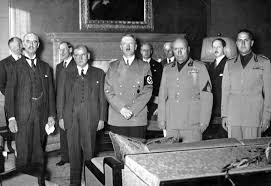
1938 Munich Agreement 
I know, I haven't posted here in The Real 80s in nine years but in line with what's happening in the world today, I feel I must venture my thoughts. A lot has happened over the years I've been away, like Covid, which forced a shutdown of most of the world but the one I want to talk about is the war between Russia and Ukraine. 

This war has been going on for three years now and has caused much death and suffering in the area. In spite of overwhelming odds, the Ukraine has been holding off the Russian onslaught, with the help of the US and European Union. However, since the election of Donald Trump as president of the United States, things have taken a worrying turn. 

President Trump has stated that he wants to end the war and be the big peacemaker. First, I don't fault him for wanting to put an end to this war. However, I object to how he is going about it and the main way is to ignore history. See, Trump wants Russia to keep the territory it originally captured in a 2013 invasion and is hinting that Russia keep the territory it has captured in its 2022 invasion of Ukraine. 

Trump and Russian president, Vladimir Putin, have been having unilateral talks without Ukraine being president. Here's where history is being ignored. Back in 1938, Great Britain and France, without inviting Czechoslovakia, agreed to give Adolph Hitler a piece of Czech territory known as the Sudetenland. British Prime Minister, Neville Chamberlain, came back waving a peace of paper saying we have peace in our time. As we all know, this only encouraged Hitler further and a year later, the world was plunged into its second world war.This is why it is imperative that Ukraine be included in any peace talks between the US and Russia.  

My question here is: Does Trump think that allowing Putin to keep captured territory, especially when international law does not recognize the acquisition of territory through military conquest, will establish peace in the region? What is worse is that the president is trying to make Volodymyr Zelensky, Ukraine's president, out to be the bad guy. He calls Zelensky a dictator who started the war. He and his followers seem to forget that Russia invaded Ukraine, not the other way around. Zelensky was democratically elected and only suspended elections on account of the war. The very same thing Winston Churchill did in World War 2. On the flip side, the US had a presidential election in 1944, which is great for democracy but it resulted in no major operations in the month before the election and could have been the cause as to why Germany was allowed to regroup and plan and carry out a counter attack in the December known now as The Battle of the Bulge. On the other hand, Russia's elections are a sham. Anyone who opposes or even speaks out against Putin is arrested. So, I ask, who's the real dictator?  


Let's face it, Donald Trump's attack on Zelensky and the Ukraine was not in the best interests of anyone. By doing so, he has alienated himself and America. As an American who lives in the UK, even the most conservative of British newspapers, many of whom are normally pro-Republican have condemned Trump for his words. If Donald Trump really wants to bring peace to Eastern Europe, he would have both Putin and Zelensky come to the table to bring about a peace deal, while respecting the rule of international law. Now, here's where the 1980s comes into it. Some Americans are balking at the government using taxpayer's money to fund a war in Europe. Actually, they are helping a nation defend itself against an agressor but I digress. Back in the 1980s, the Reagan administration used taxpayer's money to fund a bunch of so-called freedom fighters called the Contras to overthrow the government of Nicaragua. The reason was the belief that if Nicaragua became communist, the Soviets, (Russians), would use it as a jump off point the invade the US. I called it nonsense then and it still is. Reagan was Republican but Republicans today seem to forget that.

Sunday, 24 April 2011

The USA, Great Britain and History

When I first began writing "Rock And Roll Children," I did so with the intention of writing about heavy metal music back in the 80s. While the book is fiction, there are many historical facts both relating to music and not and I went through great pains to insure the historical accuracy of the events mentioned in the book. However, as an American who has lived in the UK for nearly half of his life, I have discovered that the British and Americans view historical work such as books and films in a totally different light from one another.
First, let me address the belief by many British people that all Americans believe that films such as "Saving Private Ryan" is 100% historical fact. They don't. I know the BBC likes to find one redneck who lives in Backwater USA and who believes that the film is actual history to draw the erroneous conclusion that all 280 million Americans think the same, but the truth is, the great majority of Americans don't. Many Americans already know that Hollywood does tend to over romanticise things in films and adhere to the formula that the film or book is 10% fact and 90% fiction. Therefore, when most Americans go to view a "historical" film or read a fictional historical book, they do so with this in mind.
The British, on the other hand, are a totally different kettle of fish. It appears that many British people want the film or book to be in accordance with historical fact and get very upset when Hollywood doesn't do this in films. Their beef with "Saving Private Ryan" was that it was full of historical inaccuarcies such as ignoring the mistakes that lead to the slaughter of so many American soldiers on Omaha Beach and it gave the impression that Britain wasn't involved in the D-Day landings at all. Of course, in the minds of many Britons, the worse atrocity was the film "U571" which shows Americans conducting a raid that was actually carried out by the British. Which is why I won't ever watch that film. In view of the above, most Americans think, "It's only a film, so what's all the fuss?"  and will apply the 10-90 formula.  Many can not see why so many British people got so het up about it and don't realise Britain's love for historical fact.
This brings me to "Rock And Roll Children." Americans will immediately use the 10-90 formula when reading it and early feedback seems to indicate this. The blog who gave me the bad review last month balked when I referred to the book as "an accrate account of heavy metal in the 1980s." He stated that it wasn't a book about heavy metal but a fictional story with heavy metal in it. In many ways, he's right, but what he fails to appreciate is that I went through great pains to ensure accuracy in items such as: when albums were released, concerts- when and how they happened and other events such as the PMRC Congressional Hearings in 1985 and the US bombing of Libya in 1986. Feedback from British readers seems to be more appreciative of my efforts. I remember the reaction of when British reader when I confirmed that my account of a lead singer accepting a canabis joint from someone in the crowd and taking a sly puff on it before handing it back actually happened, his face lit up and he thought that was really cool.
The point of my blog here is that the USA and Great Britain view history and fiction in totally different lights.  Americans accept that a peice of fiction based in a period of history is going to be more fiction than fact and will view or read with such mindset. British people on the other hand, want the producer or writer to "get their facts right" and will not like it if they don't. When I wrote Rock And Roll Children, I was leaning more to the British side and maybe went too far that way in the eyes of many Americans.