Monday, 12 January 2026

The Russians Are Coming, Again!


By now, most of the world knows that US president, Donald Trump, wants to annex Greenland for the United States. Furthermore, he has said that he's ready to use military force if needed. Naturally, Europe, especially Denmark, the country who actually governs Greenland, is worried that this might happen. After all, Denmark is a NATO ally and this would be considered a direct attack on Europe. 

Trump's reason for wanting to annex Greenland is to keep America safe from the Russians and Chinese. To me, that doesn't make sense because either attacked Greenland, then they would have the full force of NATO to deal with. The affair has me thinking back to the 1980s and Ronald Reagan's contra war on Nicaragua. Reagan's assertion was that if the Nicaraguan government wasn't overthrown, then the Russians were going to use it as a jump off point for the invasion of the US. So, is this a case of history repeating itself with the same old argument? 

Since the 1980s, the Sandinistas are no longer the government in Nicaragua and the Russians haven't tried to invade the US. Of course, if they wanted to do, they only need to cross 53 miles of water and they're in the continental United States and before you ask, "What would they want with Alaska?" they would get one-fifth of the US domestic oil supply and have a springboard for invading the mainland. That makes more sense than transporting troops across the ocean near to the US to stage a land invasion from the southern border. 

The same holds true for Greenland. They would have to sail past our NATO ally, Norway, who would alert the rest of NATO of what was coming and NATO could react accordingly. Any such move by Russia would result in heavy losses, even if they managed to take Greenland. It would be even more senseless for China to attempt such a move. This leads me to believe the more popular thought behind Trump's motives. While Reagan simply did not want a left wing state at America's back door, Trump wants Greenland for its resources. He is threatening to use military might for economic gain and I can't go along with that and neither does Europe. 

Saturday, 22 February 2025

Today, World War II and a Bit of the 1980s


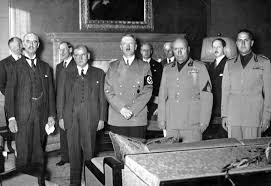
1938 Munich Agreement 
I know, I haven't posted here in The Real 80s in nine years but in line with what's happening in the world today, I feel I must venture my thoughts. A lot has happened over the years I've been away, like Covid, which forced a shutdown of most of the world but the one I want to talk about is the war between Russia and Ukraine. 

This war has been going on for three years now and has caused much death and suffering in the area. In spite of overwhelming odds, the Ukraine has been holding off the Russian onslaught, with the help of the US and European Union. However, since the election of Donald Trump as president of the United States, things have taken a worrying turn. 

President Trump has stated that he wants to end the war and be the big peacemaker. First, I don't fault him for wanting to put an end to this war. However, I object to how he is going about it and the main way is to ignore history. See, Trump wants Russia to keep the territory it originally captured in a 2013 invasion and is hinting that Russia keep the territory it has captured in its 2022 invasion of Ukraine. 

Trump and Russian president, Vladimir Putin, have been having unilateral talks without Ukraine being president. Here's where history is being ignored. Back in 1938, Great Britain and France, without inviting Czechoslovakia, agreed to give Adolph Hitler a piece of Czech territory known as the Sudetenland. British Prime Minister, Neville Chamberlain, came back waving a peace of paper saying we have peace in our time. As we all know, this only encouraged Hitler further and a year later, the world was plunged into its second world war.This is why it is imperative that Ukraine be included in any peace talks between the US and Russia.  

My question here is: Does Trump think that allowing Putin to keep captured territory, especially when international law does not recognize the acquisition of territory through military conquest, will establish peace in the region? What is worse is that the president is trying to make Volodymyr Zelensky, Ukraine's president, out to be the bad guy. He calls Zelensky a dictator who started the war. He and his followers seem to forget that Russia invaded Ukraine, not the other way around. Zelensky was democratically elected and only suspended elections on account of the war. The very same thing Winston Churchill did in World War 2. On the flip side, the US had a presidential election in 1944, which is great for democracy but it resulted in no major operations in the month before the election and could have been the cause as to why Germany was allowed to regroup and plan and carry out a counter attack in the December known now as The Battle of the Bulge. On the other hand, Russia's elections are a sham. Anyone who opposes or even speaks out against Putin is arrested. So, I ask, who's the real dictator?  


Let's face it, Donald Trump's attack on Zelensky and the Ukraine was not in the best interests of anyone. By doing so, he has alienated himself and America. As an American who lives in the UK, even the most conservative of British newspapers, many of whom are normally pro-Republican have condemned Trump for his words. If Donald Trump really wants to bring peace to Eastern Europe, he would have both Putin and Zelensky come to the table to bring about a peace deal, while respecting the rule of international law. Now, here's where the 1980s comes into it. Some Americans are balking at the government using taxpayer's money to fund a war in Europe. Actually, they are helping a nation defend itself against an agressor but I digress. Back in the 1980s, the Reagan administration used taxpayer's money to fund a bunch of so-called freedom fighters called the Contras to overthrow the government of Nicaragua. The reason was the belief that if Nicaragua became communist, the Soviets, (Russians), would use it as a jump off point the invade the US. I called it nonsense then and it still is. Reagan was Republican but Republicans today seem to forget that.

Friday, 22 January 2016

The 1980s, Hollywood and the Rambo-ization of American Youth: The A-Team


This one's a little different because it wasn't a film but a television programme. I'm sure most Americans and probably many who aren't, who were around in the early to mid 1980s would remember "The A-Team." For those who don't, "The A-Team" was about a crack military unit who served in Vietnam and were sentenced to ten years in a military prison for a crime they didn't commit. They promptly escaped and made a living as soldiers of fortune.

In each episode, they go around righting any perceived wrong brought to them by the victim. I remember in the first series, they did such things as rescue a rich man's daughter from a nut case religious cult, bust one of the team's friends out of prison while at the same time exposing the warden's illegal fight programme and help some down trodden workers form a union. In each episode there was a lot of bullets flying but rarely did anyone get hit and of course, The A-Team would win the day.

What I liked and what many people agreed made the show so successful was the characters. There was the leader of the team, John 'Hannibal' Smith played by George Peppard. In every epidsode, you could count on him saying the line, "I love it when a plan comes together." Then there was Templeton Peck, played by Dirk Benedict. He had the looks and charm to get anything for the team. Arguably the favourite of many fans was B.A. Barracus played my Mr. T. He was all muscle and power and that was what the group sometimes needed. However, my favourite character was the crazy HM Murdoch played by Dwight Schultz. When I tuned in each week, I couldn't wait to see what crazy caper he was going to get up to in that episode. He made me laugh each week. Some of my favourites are Captain Cab, the Range Rider and Bogie the Bear but the best was when we was in the prison psych unit screaming "Trash bag!" every few minutes.

Now some might be asking how did this film Rambo-ize youth? After all, some of their victories were actually on behalf of caused that might be considered left wing, like the formation of a union. Well, back in 1983, a tv review stated that the reason why the programme was so successful was because at the time, America was looking for heroes. The A-Team provided that. No matter how left or right the cause, the A-Team would solve the problem through tactics, stealth and above all, superior firepower. The show gave many young Americans the impression that problems could be solved by the use of a firearm, even if no one actually got killed and this is why Hollywood used the TV show in their quest to Rambo-ize the youth.

Wednesday, 16 December 2015

The 1980s, Hollywood and the Rambo-ization of American Youth: First Blood


It could be said that this was the first actual film to Rambo-ize American youth. After all, the main character played by Sylvester Stallone is named John Rambo. "First Blood" would begin a quadrilogy of films featuring war hero John Rambo. Three of these films would be in the 1980s while the fourth would come out twenty years later. For now though, let us content ourselves with the first one.

"First Blood" is about decorated Vietnam war hero John Rambo, now a down on his luck drifter, who has had a tough time in the civilian world. After trying to visit an old army buddy who he learns has died from cancer due to Agent Orange, Rambo drifts to the next town. There he runs foul of the town's sheriff who doesn't want drifters like Rambo in his town.

Rambo is arrested and 'cleaned up' by a couple of the sheriff's deputies who rough him up while in custody. The maltreatment results in Rambo having flashbacks to when he was a prisoner of war. He snaps, beating up the deputies and making his escape. The local police chase him but he gets them using a series of guerrilla tactics. When the police fail to catch him, the national guard is called in. In the mean time, Rambo's former CO is brought in to try to convince Rambo to surrender. However, things erupt into a minor war and the CO is only able to convince Rambo to give himself up at the end after he inflicts a lot of damage on people and the town, some great explosions by the way.


I could sympathize with John Rambo straight away, as I was serving in the military at the time the film came out. His speech at the end of how he went to war, did everything to win but wasn't allowed to win and then came home to indifference and even scorn was heart wrenching for me. This was the first film I saw that actually tried to show some sympathy to those who served in Vietnam. My reaction was that it was about time the country did and I feel that if America apologized every day until the last Vietnam Veteran passed away, it might just be enough to address the damage done to them.

Now here's the but. The Reagan administration was in full favour of films which honoured those who served in Vietnam. Nothing wrong with that except the then president had an alternative motive for doing so. He so badly wanted to go to war in Central America despite cries of it leading to another Vietnam style war. Therefore, if he honoured the veterans and forwarded the belief that America could have won the war, then the country would have been more receptive to his militaristic ideals. The film's success in building sympathy towards the Vietnam Veterans went a way towards this aim.


Monday, 21 September 2015

The 1980s, Hollywood and the Rambo-ization of American Youth: Taps


Unlike "Stripes" which approached things with humour, the late 1981 film "Taps" did so more seriously. The movie is about long standing military school which faces closure and that closure becomes more definite when a local boy is accidentally shot and killed in a fight between students at the school and some local townspeople. Of course, the townspeople are all a bunch of long haired drunken yobs. The students decide that they don't want to lose their beloved school so, they take up arms to defend it. Thus starts a long siege with the state police and then the national guard before it all comes to bloody end.

"Taps" deals with two main topics. From the point of view of the students, they believe in old fashioned traits like duty, honour and country. They see themselves as noble people with an honouralbe cause. However, their sense of honour is truly tested and strained throughout the film. Furthermore, they are further skewed by the view of the peace loving civilians who care little for the noble traits the students have. To them, the students are all brainwashed radical warmongers. What I did like about the film, though the point of this is not to rate it, is how the colonel of the national guard points out that the value system of the students is off base. That a true soldier wants to live and not die for their cause.

While the film comes to a bloody end, it's not full of action packed combat scenes. In fact, the film was slated by critics for having the siege drag on a bit too long. What "Taps" is trying to ram home is that American values like duty, honour, courage and loyalty to one's country aren't something that should go away. It does a good job of building sympathy towards those serving in uniform and serving isn't something bad. That was exactly what the purpose of the film was.


Friday, 28 August 2015

The 1980s: Hollywood and the Rambo-ization of American Youth- Stripes


It may seem odd that the first film I would choose in my look at the Rambo-ization of American youth in the 1980s would be the comedy spoof "Stripes." For those who have never seen this 1981 comedy classic, it stars Bill Murray as the bumbling John Winger who joins the army because he has no other alternatives in life. As soon as he joins, he finds that his antics cause him to fall foul of old time army drill sergeant Sgt. Hulka leading to some hilarious confrontations and mishaps. After comically saving his platoon at basic training graduation, they are all posted to Europe to train with the army's latest combat vehicle, the M150. After Winger and his friend take the vehicle to Germany to spend a romantic weekend with two female MPs, the rest of the platoon, led by the incompetent Captain Stillman, go off to find them and bring them back. The Captain gets lost and they end up in Czechoslovakia and are captured by the Russians. When Murray, his friend and the two ladies discover this, they take the vehicle with all its new weapons and rescue their comrades, which they do and return home as heroes. It is all very comically well done and there are laughs galore throughout the entire film. One of the most famous parts is when Murray responds to a question asked by a general with "That's the fact, Jack!"

Films like "Stripes" prove that Americans have a fantastic sense of humour. Nothing is more funnier than watching watching Bill Murray and pals bumble their way through the film and very comically defeat those nasty Russians. Especially as no one actually gets killed in the film. I have watched this film many times and I still laugh just as loudly as when I saw it for the very first time.

Those of you who have seen "Stripes" maybe asking how a film like this could like this could Rambo-ize youth. The answer is that standing alone, the film doesn't. It's actually quite harmless taken in context. However, many people the world over like to approach things with a bit of humour. Sure, we all laughed through the film and despite what I am writing here will do so should I see it again. The film is quite harmless in a war sense but since the film approaches things with humour, it formed a base for future films when they would become much more serious. What better way to get American youth to think in a more militaristic way than by laughing at the antics of comedy hero Bill Murray while he serves his country and becomes a hero.

Next post: Taps


Saturday, 22 August 2015

The 1980s: Hollywood and the Rambo-ization of American Youth


In 1986, when President Reagan was visiting a high school in a town not far from my own, some like minded friends and myself went there to show our disapproval for his policy on Central America. Naturally, the pro- Reagan crowd were highly resentful of our presence there and made their feelings known. Even to the point where one lady told us where we could stick our first amendment rights. There was the one boy, about fifteen or sixteen who called us 'Commies' (original I know) to which I responded with, "It will be you they'll be sending to fight down there." The smart ass replied with, "I wanna go." I mentioned this to one of my fellow protesters who sarcastically, but seriously stated, "Of course he's not going to die, he's Rambo!"

The film "Rambo, First Blood Part II" had been released a year earlier and many Americans, especially males, had taken the character played by Sylvester Stallone to heart. He was America's new hero and everybody wanted to be like him. I have been pondering this over the past thirty years or so and I have come to the conclusion that it wasn't just one film that turned young American boys into wannabe war heroes. In fact, it has been a steady stream of films since the election of Ronald Reagan as president that lead to this.

After nearly three decades of letting this swim around in my brain, I am going to put my theory into words here. I will be looking at the films made in the 1980s and demonstrate that Hollywood played a part in Rambo-izing American youth. I admit that due to many other commitments in my life, I won't be able to post regularly, but will do so whenever I get the chance. Of course, if these posts lead to a lot of response and debate, then I will definitely post more regularly.

Next post: Stripes